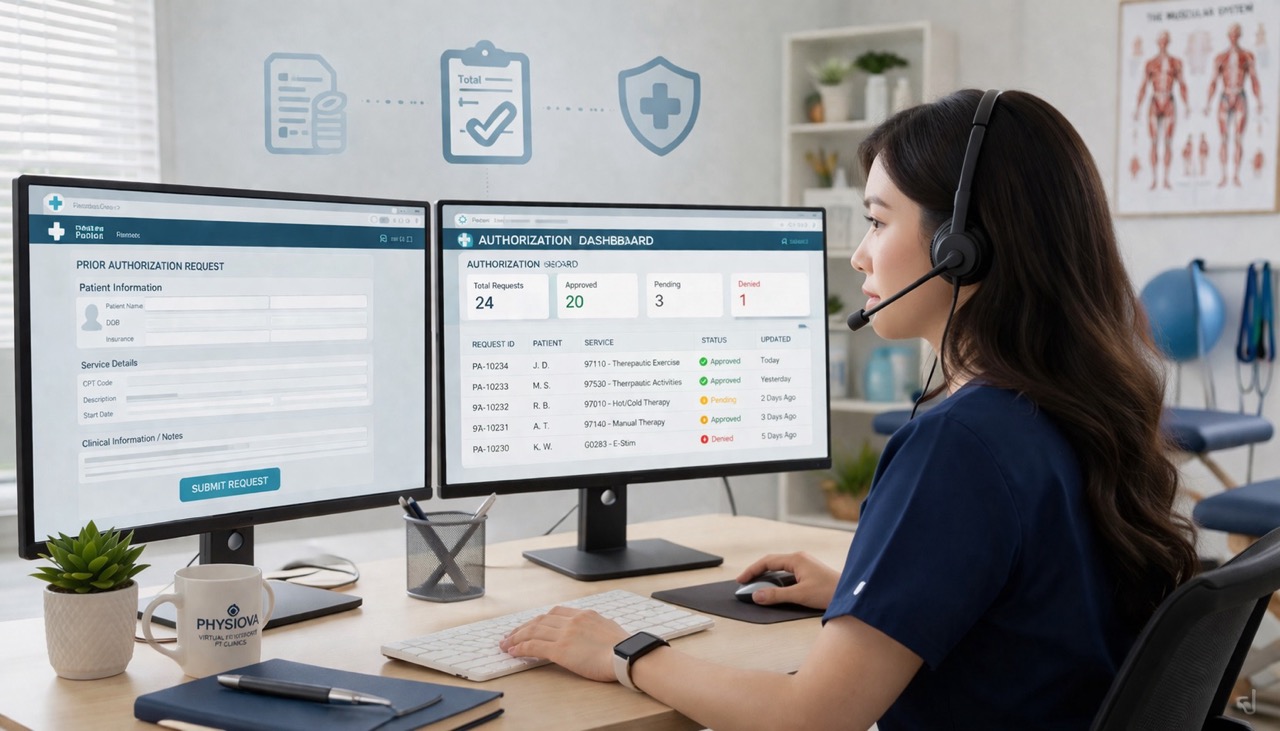
In 2026, physical therapy prior authorization is the biggest threat to patient access and clinic revenue in outpatient rehab. Payers keep adding services to their “Auth Required” lists. Approval windows are shrinking. Documentation rules are getting stricter. One missed authorization can wipe out an entire plan of care — sometimes months after those visits happened.
Are you managing auth requests between sessions? Chasing payer portals at midnight? Watching your scheduler drown in hold queues with Aetna and United? Then you are not running a clinic. You are running a clearinghouse — at the wrong price point.
To win in 2026, you need a specialized Physical Therapy Virtual Assistant who treats prior authorization as the revenue gate it truly is — not a clerical task.
What is a PT Prior Authorization Virtual Assistant?
A Physical Therapy Virtual Assistant (PT VA) focused on prior authorization is a managed-care expert. They work remotely but connect directly into your scheduling, EMR, and payer workflows. A general medical admin submits auth requests and waits. A specialized PT VA does something different. They manage the full authorization lifecycle — from the first referral to the final collected visit.
They don’t just “request auths.” They build the clinical story that gets them approved.
The PT Prior Authorization Specialist Difference
In 2026, a generalist VA is a liability. A specialized Physical Therapy Virtual Assistant brings precision to your authorization workflow:
- Payer-Specific Knowledge: They know that Cigna requires a functional outcome measure on every initial auth request, that Blue Shield of California has a 48-hour expedited review window, and that Medicare Advantage plans through Humana have tightened their PT visit caps to 20 units per rolling calendar year.
- CPT & Diagnosis Alignment: They understand which ICD-10 codes trigger automatic auth requirements versus which ones qualify for “deemed authorized” status — and they build every submission to preempt a medical necessity challenge.
- Platform Proficiency: Expertise in payer portals including Availity, NaviMedix, AIM Specialty Health, and eviCore — the gatekeepers that control the majority of your outpatient PT volume.
- The Appeal Architecture: When an auth is denied, they don’t resubmit the same request. They draft a clinical peer-to-peer justification brief that gives your treating therapist a structured script for the physician reviewer call.
The Bottom Line: A specialized Physical Therapy Virtual Assistant doesn’t ask you what “auth units” means. They ask you for your rendering provider NPI and your payer list — so they can go build the authorization grid before your scheduler books the first eval.
The Cost of Authorization Chaos: The “Phantom Revenue” Problem
Every unmanaged auth gap creates Phantom Revenue. These are visits your therapist delivered but your clinic cannot collect. The authorization was missing, expired, or over the approved limit.
| Role | Effective Hourly Rate | Monthly Impact (20 hrs/week) | Opportunity Cost |
|---|---|---|---|
| Clinic Owner / PT | $120 – $160 | $9,600 – $12,800 | Extreme: Retro-denials & clinical burnout |
| In-House Admin | $30 – $35 | $2,400 – $2,800 | Moderate: Undertrained & overwhelmed |
| PhysioVA (Specialist) | $12 | $960 | Zero: Proactive auth management at scale |
Your Physical Therapy Prior Authorization Shield: The 24/72/7 Framework
At PhysioVA, your Physical Therapy Virtual Assistant operates on a structured “Authorization Shield” framework designed so that no patient ever sits in your chair without confirmed coverage.
- 24 Hours (The Pre-Appointment Check): Every scheduled patient is verified for active authorization status 24 hours before their visit. If an auth is missing or expired, your VA initiates a real-time request — not a voicemail.
- 72 Hours (The Initial Decision Window): Every new authorization request is followed up within 72 hours of submission. If a payer has not issued a decision, your VA escalates to an urgent review and documents the escalation trail for potential retro-authorization.
- 7 Days (The Utilization Review): Every Friday, your VA generates a “Visit Burn Report” — a snapshot of how many authorized visits each active patient has remaining versus how many are scheduled. No patient reaches their last authorized visit without an extension request already in queue.
Key Services Provided by a Specialized PT VA
To protect your revenue from physical therapy prior authorization gaps, your clinic needs a specialist who owns the full authorization cycle. As authorization complexity is not going away — and physical therapy prior authorization management is only getting more demanding:
- Eligibility & Auth Requirement Screening: Confirming not just active coverage, but whether the specific CPT codes your therapist plans to use require authorization — before the eval is booked.
- Initial Authorization Submission: Building the clinical justification package — including functional deficits, prior treatment history, and outcome measure baselines — that meets 2026 payer standards for medical necessity.
- Concurrent & Extension Requests: Submitting continuation auth requests with updated functional progress data so your therapist never has to stop a plan of care mid-protocol due to an expired auth.
- Peer-to-Peer Coordination: Scheduling and briefing peer-to-peer review calls between your treating PT and the payer’s medical director when an initial denial requires clinical escalation.
- Retro-Authorization Recovery: When a visit is delivered without a valid auth — due to a payer error, a system gap, or a last-minute scheduling change — your VA pursues retro-auth through the documented escalation path before the claim is submitted.
Why Physical Therapy Prior Authorization Requires a Specialist in 2026
The authorization landscape of 2026 is dominated by Managed Care AI — algorithmic gatekeeping systems like eviCore and AIM that cross-reference your submitted clinical data against population benchmarks. A $3/hr generalist from a generic agency doesn’t know that submitting a lumbar fusion post-op case under M54.5 (Low Back Pain) instead of M96.1 (Post-procedural Syndrome) will auto-deny in eviCore 94% of the time.
PhysioVA was founded by Physical Therapists who understand that authorization management is not a front-desk task — it is a clinical-administrative discipline. By preventing just three retro-denials per month, a specialized Physical Therapy Virtual Assistant more than covers her entire monthly cost — and protects the clinical relationships you have worked years to build.
Your 30-Day Authorization Stabilization Roadmap
Moving from “auth chaos” to “auth clarity” follows a proven 30-day onboarding path:
- Day 1–7: The Auth Audit. Your PT VA maps every active patient’s authorization status, identifies any visits delivered under expired or missing auths, and immediately initiates retro-auth recovery on any recoverable claims.
- Day 8–14: The Intake Protocol. We implement a “Zero-Gap Scheduling” rule: no patient is confirmed on the schedule without an authorization number or a documented exemption in the chart.
- Day 15–30: The Ownership Shift. Your VA takes over the weekly “Authorization Dashboard” briefing — a real-time view of pending auths, expiring approvals, and visit utilization rates by payer — so you start every week knowing exactly where your authorized revenue stands.
Don’t Let Payer Gatekeeping Write Your 2026 Story
Authorization complexity is not going away. Every major commercial payer has expanded managed care review in 2026, and the clinics that will thrive are the ones that stop treating authorization as an afterthought and start treating it as the first line of revenue defense.
To win this year, you need more than a scheduler who “handles the auth stuff.” You need a Physical Therapy Virtual Assistant who turns your authorization workflow into an automated shield — so your therapists treat patients, not paperwork.
Reclaim 10+ hours this week and ensure every authorized visit is a visit you collect. The “Protected Clinic” starts here.
Connect with a PhysioVA Specialist Today